

原创 大理州崇圣寺三塔文化旅游区导游词(中英文)
Three Pagodas of Chongsheng Temple — Guide Script
模拟团型:老年团 | Simulated Group Type: Senior Citizens' Tour
讲解顺序 | Order of Commentary:
景区概况 → 大理历史 → 白族文化 → 三塔布局 → 千寻塔 → "永镇山川"照壁 → 两座小塔
Overview → History of Dali → Bai Culture → Layout of the Three Pagodas → Qianxun Pagoda → "Yong Zhen Shan Chuan" Screen Wall → The Two Smaller Pagodas
老年团讲解要点 | Notes for Guiding a Senior Group:
- 语速放慢,音量适中,多停顿;每到台阶、坡道处提前提醒。
Speak slowly and clearly, at a comfortable volume, with natural pauses; give advance notice before every step or slope.
- 全程约2.5–3小时,途中安排2–3次休息,提醒补水、防晒/保暖。
Allow roughly 2.5–3 hours total, with 2–3 rest breaks; remind guests to drink water and dress for the weather.
- 讲解内容以故事性、趣味性为主,减少年代堆砌,多用类比。
Favor storytelling and easy analogies over dense dates and figures.
- 常用称呼:"各位叔叔阿姨""各位老人家",语气亲切、放慢节奏、多互动确认。
Address the group warmly ("aunties and uncles," "dear friends") and check in often to make sure everyone is following comfortably.
一、开场与景区概况 | Opening & Overview
中文:
各位叔叔阿姨,大家早上好!欢迎大家来到大理,来到咱们今天行程里最重要的一站——崇圣寺三塔文化旅游区。我是大家今天的导游,姓王,大家可以叫我小王。
咱们现在所在的位置,就在大理古城北边,走一走大概一公里半就到了,背靠苍山,面朝洱海,这个位置啊,用一句话讲,就是"依山傍水,风水宝地"。崇圣寺三塔呢,早在1961年就被国务院列为首批全国重点文物保护单位,2011年又评上了国家5A级景区,是咱们云南最有分量的一张文化名片。
今天时间比较宽裕,咱们不赶路,走走停停,大概安排两个半到三个小时,中途会找阴凉的地方给大家安排休息、喝水。大家如果走累了,随时跟我说一声,咱们放慢脚步,路上台阶的地方我都会提前提醒大家,扶好栏杆,慢慢走,安全第一。
English:
Good morning, everyone! Welcome to Dali, and to what's easily the highlight of today's trip — the Three Pagodas of Chongsheng Temple. My name is Wang, and I'll be your guide today — feel free to just call me Xiao Wang.
We're now about a kilometer and a half north of Dali's Old Town, with Cangshan Mountain at our backs and Erhai Lake stretching out in front of us — honestly, it's hard to imagine a better spot, tucked between mountain and lake. The Three Pagodas were placed on China's very first list of nationally protected cultural relics back in 1961, and in 2011 the site earned the country's top 5A tourism rating. It's one of Yunnan's true cultural treasures.
We've got plenty of time today, so there's no need to rush — we'll walk at an easy pace, with stops along the way, and I'll plan two or three breaks in the shade so everyone can rest and have some water. If anyone needs to slow down at any point, just let me know. I'll always give you a heads-up before any steps or slopes — please hold the railings and take your time. Safety first.
二、大理历史 | A Short History of Dali
中文:
说起大理,咱们得先说说这座寺庙的来历。崇圣寺最早建于南诏国的中后期,那个年代佛教特别兴盛,家家户户信佛。到了后面的大理国时期,佛教更是达到了顶峰。
大家可能不知道,大理国历史上一共有九位国王,年纪大了以后,不当皇帝了,直接跑到崇圣寺出家当和尚,这在整个中国历史上都是非常罕见的。所以那个时候,大理有个别名,叫"佛国",也叫"妙香国",崇圣寺呢,被称为"佛都"——当年规模最大的时候,占地约2.5平方公里,有楼阁三座、佛塔七座、大殿九间、房屋890间,供奉佛像11400尊,一度是整个东南亚最大的佛教寺院。
可惜好景不长,清代咸丰、同治年间战乱不断,寺庙被毁得差不多了;1925年大理又遭遇了一场大地震,最后就只剩下咱们今天看到的这三座塔,孤零零地立在那儿,一站就是好几百年。一直到2005年,经过重建,才有了咱们现在看到的崇圣寺新貌。所以大家等一下看到的,是"塔"和"寺"两个不同年代的故事——塔是千年古物,寺是本世纪重建的。
English:
To understand this temple, we need to start with a bit of history. Chongsheng Temple was first built in the mid-to-late Nanzhao Kingdom, a time when Buddhism was flourishing across the region. By the following Dali Kingdom era, it had reached its peak.
Here's something you might not expect: nine different kings of the Dali Kingdom, once they grew older, actually stepped down from the throne and came here to become monks — something almost unheard of anywhere else in Chinese history. That's how Dali earned nicknames like "the Kingdom of Buddhism," and Chongsheng Temple came to be called the "Capital of Buddhism." At its peak, the complex covered about 2.5 square kilometers, with three pavilions, seven towers, nine main halls, 890 rooms, and 11,400 Buddha statues — at one point, it was the largest Buddhist temple anywhere in Southeast Asia.
Sadly, it didn't last. War during the Qing dynasty's Xianfeng and Tongzhi reigns destroyed most of the temple, and a major earthquake in 1925 finished what was left — leaving only the three pagodas you'll see today, standing alone for centuries. It wasn't until 2005 that the temple was fully rebuilt into what you see now. So keep in mind: the pagodas are the original, thousand-year-old relics, while the temple buildings around them are this century's reconstruction — two different stories from two very different eras.
三、白族文化 | Bai Ethnic Culture
中文:
大理是白族聚居的地方,咱们今天看到的这一整片建筑,其实处处都能看到白族文化的影子。白族人自古信奉佛教,也特别看重"和"字——和睦、和气。三塔的选址、布局,包括后面咱们会看到的一些雕刻图案,都融合了白族的审美习惯,比如喜欢用白色、青色做主色调,讲究对称、讲究天人合一。
另外提一句,白族人待客特别讲究,有名的"三道茶"——一苦、二甜、三回味,说的就是人生的道理,先苦后甜,苦尽甘来。大家一会儿如果时间允许,可以在附近体验一下,也算是感受一下咱们白族的待客之道。
English:
Dali is home to the Bai ethnic group, and you'll see their cultural fingerprints all over the complex we're about to explore. The Bai people have long embraced Buddhism, along with a deep value for harmony and hospitality. The placement of the pagodas, the layout of the grounds, and even the carvings you'll see later all reflect Bai aesthetic traditions — a preference for white and blue-green tones, a love of symmetry, and the idea of harmony between people and nature.
One more thing worth mentioning: the Bai people are famous for their hospitality, especially their "Three-Course Tea" — bitter first, then sweet, then a lingering aftertaste. It's meant to mirror life itself: hardship first, sweetness later. If we have time, it's well worth trying nearby — a nice way to experience Bai hospitality firsthand.
四、三塔布局 | Layout of the Three Pagodas
中文:
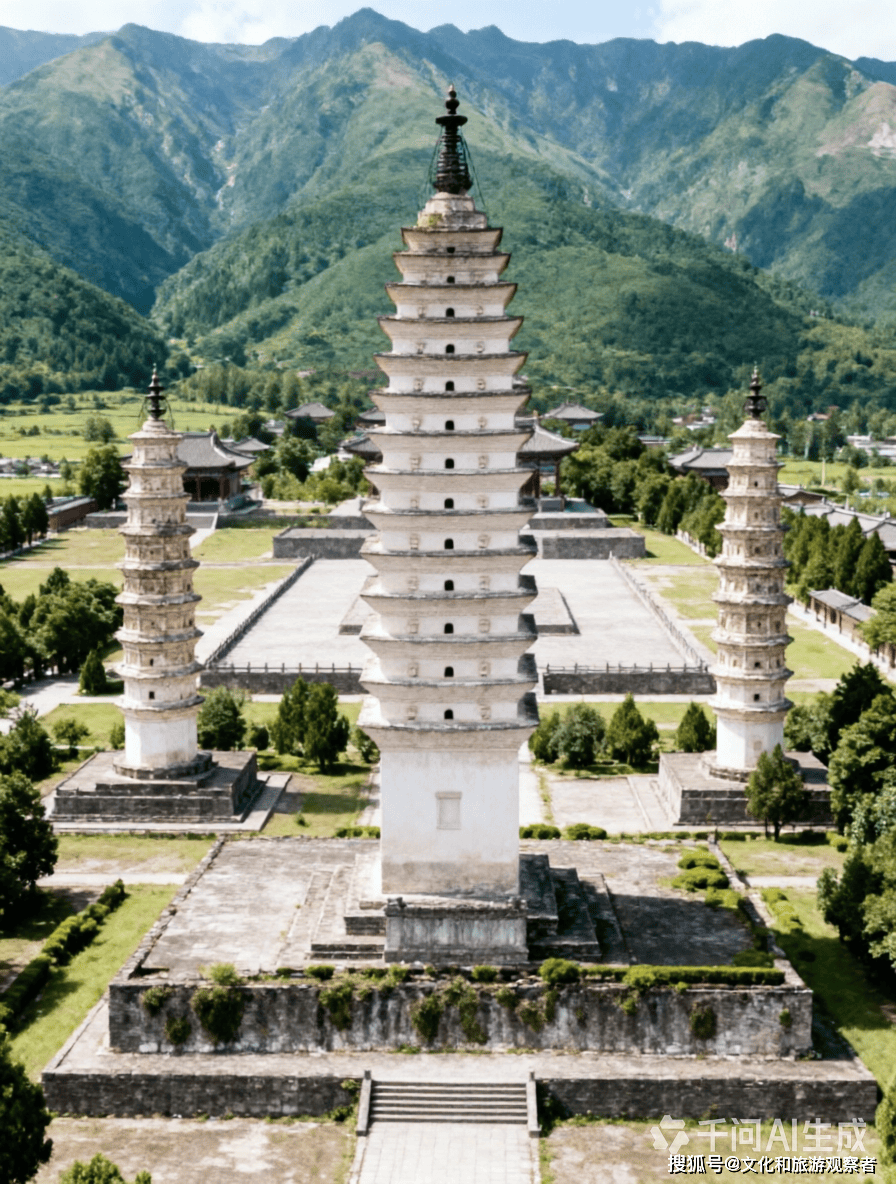
好,各位往前面看,咱们现在能看到的,就是三塔了——中间这座又高又大的,叫千寻塔;两边稍微小一点的,一南一北,遥遥相望,这就是三塔"三足鼎立"的格局,像咱们平时说的"三条腿的板凳",稳稳当当。
这三座塔啊,从唐代、大理国一直站到今天,中间经历了三十多次地震,居然一次都没倒,可以说是咱们建筑史上的一个奇迹。1978年维修的时候,工作人员还从塔里意外挖出了680多件珍贵文物,一下子轰动了整个文物界。咱们等一下会分别走近千寻塔,还有南北两座小塔,慢慢给大家介绍。
这一片地势比较平坦,大家可以放心走,我们先往千寻塔这边走,走两三分钟就到。
English:
Now, if everyone looks ahead, this is where you'll see all three pagodas at once — the tall one in the middle is Qianxun Pagoda, and the two smaller ones on either side, facing each other from the north and south, complete the "tripod" formation — like a sturdy three-legged stool that never tips over.
These three pagodas have stood here since the Tang dynasty and the Dali Kingdom, surviving more than thirty earthquakes without ever collapsing — genuinely one of the great feats of Chinese architectural history. During restoration work in 1978, workers even uncovered over 680 precious artifacts hidden inside, which made headlines across the entire heritage world at the time. We'll walk up to Qianxun Pagoda first, then visit the two smaller pagodas, and I'll tell you more about each one along the way.
The path ahead is nice and flat, so there's no need to worry — let's head toward Qianxun Pagoda now, it's just a two- or three-minute walk.
五、千寻塔 | Qianxun Pagoda
中文:
各位老人家,咱们现在站的位置,正对着的就是主塔——千寻塔。这座塔建于唐代,是一座空心的砖塔,一共十六层,高69.13米,差不多相当于二十多层楼那么高。它有个特别的地方——在全国所有偶数层的塔里,它是最高的一座。
大家仔细看塔身,每一层每一面都开着小佛龛,原来里面是供着佛像的。塔内原来是有楼梯可以爬到顶层的,站上去能把苍山洱海一览无余,风景特别开阔——不过考虑到咱们今天体力安排,就不建议大家爬塔了,咱们在下面拍拍照、慢慢欣赏就很好。
English:
Everyone, right in front of us now is the main tower — Qianxun Pagoda. Built during the Tang dynasty, it's a hollow brick structure with sixteen stories, rising 69.13 meters — roughly the height of a twenty-story building. It actually holds a national record: among all pagodas in China with an even number of stories, this is the tallest.
If you look closely at the tower, you'll notice small niches on every level and every side — these once held Buddha statues. There used to be a staircase inside leading all the way to the top, with sweeping views of both the mountain and the lake. Given today's pace, though, we won't be climbing it — it's just as lovely to admire from down here and take some photos.
六、"永镇山川"照壁 | The "Yong Zhen Shan Chuan" Screen Wall
中文:
好,大家转过身来,看塔前面这面墙——这叫照壁,朝东立着,上面刻着四个大字:"永镇山川"。这四个字写得非常有气势,一个字就有1.7米高,是明代黔国公沐英的孙辈所写。
这四个字什么意思呢,民间有两种说法。第一种说法比较有趣:说塔顶站着一只大鹏鸟,能镇住水里的龙,所以能防洪水、保平安;第二种说法呢,讲得比较实际:说这其实是明朝朝廷在表明态度,要牢牢守住、掌控大理这片地方——你看这塔立在这儿,千百年都不会倒,就是这份"永镇"的决心。
两种说法呢,一个偏神话传说,一个偏历史政治,大家可以自己品一品,都挺有意思。
English:
Now, if everyone turns around, you'll see this wall standing in front of the pagoda, facing east — this is called a screen wall, and it's inscribed with four large characters: "Yong Zhen Shan Chuan," roughly meaning "eternally guarding these mountains and rivers." The characters are quite striking — each one stands 1.7 meters tall — and they were written by a grandson of Mu Ying, the Ming-dynasty Duke of Qian.
As for what the inscription actually means, there are two popular explanations. The first is more of a folk legend: a giant roc is said to perch atop the pagoda, holding down a dragon in the water below to prevent floods and keep the region safe. The second is more of a historical reading: it's seen as a political statement from the Ming court, declaring its firm control over Dali — with the pagoda's permanence, standing unmoved for centuries, symbolizing that lasting grip. One explanation leans toward myth, the other toward history — either way, it's a fun bit of local lore to think about.
七、南北小塔 | The Two Smaller Pagodas
中文:
好,各位随我往这边走几步,不着急,咱们去看看南边和北边这两座小塔。它们各自离主塔大概70米,一南一北,遥遥相对,和千寻塔一起,正好凑成三足鼎立的格局。
现在比较主流的说法,认为这两座塔建于大理国段正严、段正兴在位时期,也就是公元1108年到1172年之间,距今差不多九百年了。塔高42.19米,一共十层,是八角形的密檐砖塔,外形是锥形的,带着典型的宋代建筑风格。大家如果凑近看,会发现塔身上有浮雕,刻着佛像、莲花、宝瓶,一层一个样,特别精细。塔顶盖着琉璃瓦,底座是两层八角形的台子,整体看上去比主塔更秀气、更精巧一些。
好,到这里呢,咱们今天关于三塔部分的讲解就先告一段落。这三座塔啊,历经千年、扛过三十多次地震,依然稳稳站在这里,我觉得特别像咱们在座各位——经历了这么多风风雨雨,依然精神矍铄地站在这里,跟我们一起看风景。接下来大家可以自由拍照留念,咱们十五分钟后在照壁前集合,然后一起去看看建极钟和雨铜观音殿,好不好?
English:
Alright, everyone, let's walk a few steps this way — no rush — to take a look at the two smaller pagodas, one to the south and one to the north. Each stands about 70 meters from the main tower, facing each other, and together with Qianxun Pagoda they complete that tripod formation we talked about earlier.
The most widely accepted view today is that these two pagodas date to the reign of Duan Zhengyan and Duan Zhengxing of the Dali Kingdom — roughly 1108 to 1172 CE, so nearly nine hundred years old. Each stands 42.19 meters tall, with ten stories, octagonal in shape with closely set eaves and a conical silhouette, showing clear Song-dynasty stylistic influence. If you look closely, you'll spot relief carvings on the surface — Buddha figures, lotus blossoms, vases — with the design changing from one level to the next. Each is topped with a glazed roof and rests on a two-tiered octagonal base, giving them a more delicate, refined look compared to the main tower.
That brings us to the end of our tour of the Three Pagodas for now. Having stood here for a thousand years, surviving more than thirty earthquakes, they remind me a little of all of you — after everything life has thrown your way, you're still here, standing strong and taking in the view with us. Feel free to take some photos here, and let's meet back at the screen wall in fifteen minutes — from there, we'll head over to see the Jianji Bell and the Hall of the Rain Bronze Guanyin. Sound good?(陈大衡和他的AI)