

《环球时报》专访圣彼得堡陈志刚:免签政策为中俄旅游注入“强心剂”
圣彼得堡俄中商务园总裁陈志刚接受环球时报专访原文如下:
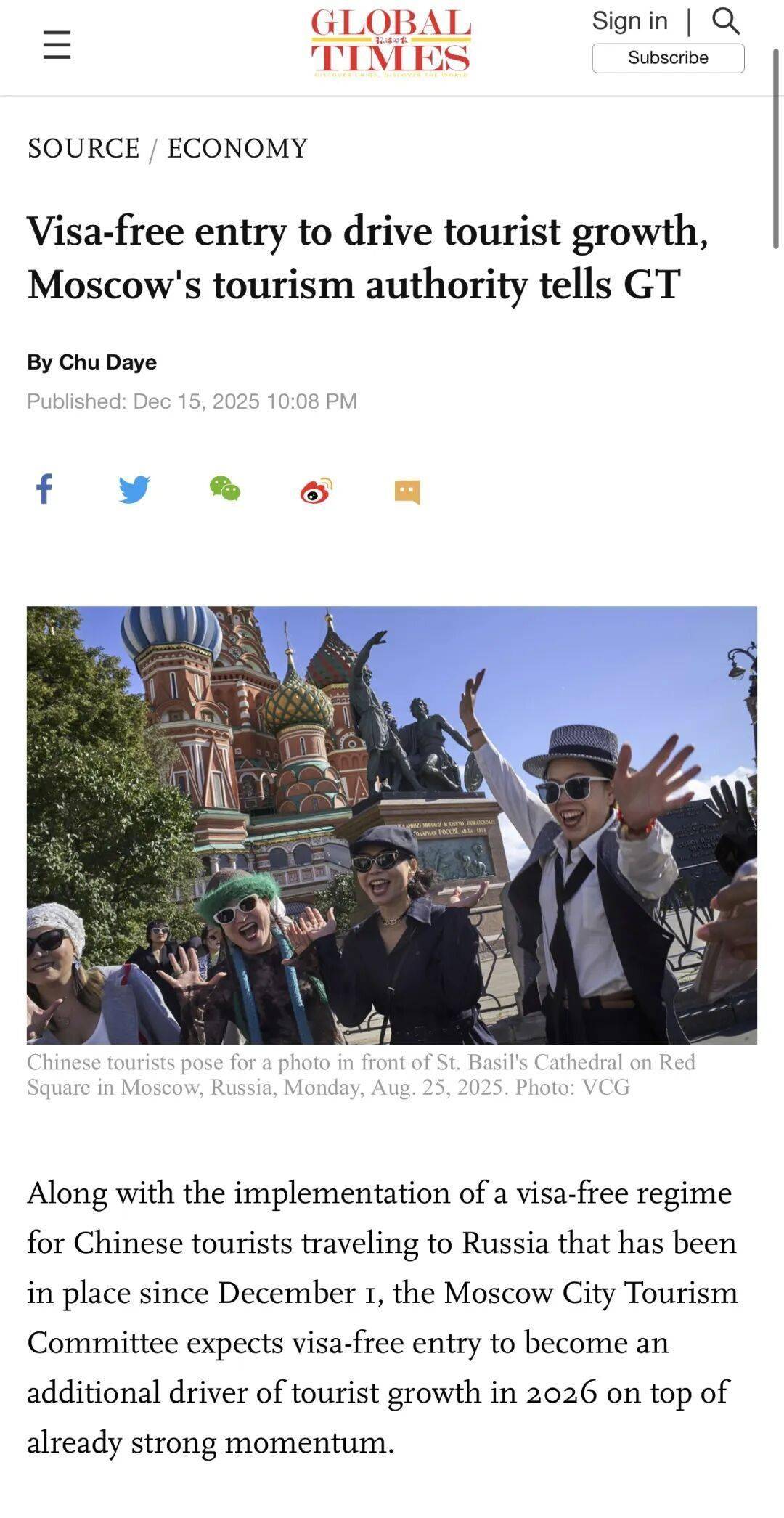
自12月1日俄罗斯对中国游客实施免签制度以来,莫斯科市旅游委员会预计,在旅游业已有的强劲发展势头基础上,免签入境将成为2026年游客增长的又一驱动力。
过去十年间,中国游客前往俄罗斯首都的出行次数已超过400万次。该委员会在周一发给《环球时报》的电子邮件声明中表示:“这一长期趋势清楚地证明,中国是莫斯科最重要、最稳定的国际旅游市场之一。”
委员会称,官方数据显示,仅2025年上半年,就有约23万名中国游客到访莫斯科,同比实现强劲稳定增长,这表明中国游客对莫斯科的兴趣持续高涨。
据塔斯社报道,俄罗斯总统弗拉基米尔·普京于12月1日签署法令,允许包括游客、商人、学者、艺术家和运动员在内的几类中国公民免签入境俄罗斯,最长可停留30天。
莫斯科市旅游委员会表示,这一具有里程碑意义的决定使前往莫斯科的旅行比以往任何时候都更加便捷,而每周超过100个直飞航班的发达航空网络是另一个推动因素。
委员会指出,尽管自由行游客的比例逐年上升,但简化的签证制度可能会进一步推动该市非团队游的增长。免签入境大幅减少了旅行障碍,鼓励了即兴出行、短期城市游和个性化行程安排。
委员会称,在到访莫斯科的非独联体国家游客中,中国游客数量始终位居第一。
随着旅行便利化政策的实施,中国游客的兴趣也日益浓厚。多家中国在线旅游平台报告称,自该政策实施以来,俄罗斯目的地的搜索量激增。
此外,2024年中国游客的出行数据表现强劲,委员会将其评为中国市场的“里程碑式一年”。数据显示,2024年中国游客到访量达42.91万人次,中国稳步回归莫斯科主要国际入境客源地之列。
委员会表示,过去一年的一个重要特点是游客构成的变化——近24%的中国游客赴莫斯科是出于商务目的,这印证了商务旅游的重要地位。大多数游客采用了简化入境机制,事实证明这种方式既便捷又高效。
委员会预测,在稳定的航空网络和中文数字服务的支持下,自由行和商务旅行都将持续增长。
委员会还指出,游客对文化旅游、活动旅游和季节性旅游的兴趣预计也将增强。随着莫斯科与中国的文化交流不断深化,2026年旅游业有望进一步发展。
部分行业人士表示,俄罗斯新实施的对华免签政策将进一步扩大两国经济合作,深化人文交流,为中俄关系长期发展奠定更坚实的基础。
圣彼得堡俄中商务园总经理陈志刚周一告诉《环球时报》,互免签证政策对双边人文交流具有历史性意义。
“过去几个月,中国游客对俄罗斯旅游资源的关注度一直在稳步上升,”陈志刚说,他经常组织中国游客赴俄团队游。
陈志刚预测,两国人员互访量将大幅增长,增长动力主要来自中国。“特别是可支配收入较高的中国游客,将为俄罗斯旅游业带来利好。”
一位在该政策实施前不久赴俄旅行的中国游客表示,新的免签制度将成为双边旅游的“加速器”。
“个人游客申请电子签证每人约需400元人民币(合56.70美元),因此免签政策不仅省去了申请电子签证的流程,还节省了费用。感觉就像友好的俄罗斯人在旅行开始前就给每位中国游客送了一只帝王蟹,”这位李姓游客周一告诉《环球时报》。
委员会表示,为了满足“日益增长的”中国游客需求,莫斯科旅游部门在2025年着力改善了中国游客的出行舒适度、便捷性和导航服务。
相关部门扩大了中文数字服务范围,网站提供现成的旅行路线、文化项目和活动信息。莫斯科也是俄罗斯首个在携程平台开设官方账号的城市,以帮助游客规划行程。此外,主要交通枢纽和热门景点还增设了中文标识,为游客在莫斯科市区及地铁内出行提供了便利。
Visa-free entry to drive tourist growth, Moscow's tourism authority tells GT
Along with the implementation of a visa-free regime for Chinese tourists traveling to Russia that has been in place since December 1, the Moscow City Tourism Committee expects visa-free entry to become an additional driver of tourist growth in 2026 on top of already strong momentum.
Over the past decade, travelers from China have made more than 4 million trips to the Russian capital. "This long-term dynamic clearly confirms China's status as one of Moscow's most important and stable international tourism markets," the committee said in an email statement sent to the Global Times on Monday.
According to official data, some 230,000 Chinese tourists visited Moscow in the first half of 2025 alone, demonstrating strong and stable year-on-year growth, as Chinese tourist interest in Moscow continues to surge, the committee said.
Russian President Vladimir Putin signed on December 1 a decree granting visa-free entry to Russia for up to 30 days for several categories of Chinese citizens, including tourists, businesspeople, academics, artists, and athletes, according to the TASS news agency.
This landmark decision makes travel to Moscow easier than ever, while developed air connectivity with more than 100 direct flights per week is another boosting factor, according to the Moscow City Tourism Committee.
Although the share of independent travelers has been increasing year-on-year, the simplified visa regime could provide an additional boost for the growth of non-group travel to the city. Visa-free entry significantly reduces travel barriers, and it encourages spontaneous trips, short city breaks, and personalized itineraries, according to the committee.
China consistently ranks first among non-Commonwealth of Independent States countries in terms of the number of tourists visiting Moscow, the committee said.
In a demonstration of rising interest that comes along with the travel facilitation, several Chinese online travel agencies have reported a surge in searches for Russian destinations since the policy was implemented.
Also, the performance from Chinese tourists was strong in 2024, with the Committee assessing it as a "landmark year" for the Chinese market. With 429,100 visits, China firmly returned to its position as one of Moscow's key international inbound sources, the committee said.
An important feature in the past year has been the structure of arrivals, with nearly 24 percent of Chinese visitors who traveled to Moscow doing so for business purposes, confirming the strong role of business tourism, the committee said. The majority of travelers used simplified entry mechanisms, which proved both convenient and effective.
The forecast points to continued growth in both independent and business travel, supported by stable air connectivity and the availability of digital services in Chinese, the committee said.
The committee noted that interest in cultural, event-based, and seasonal tourism is also expected to strengthen, while further expansion is anticipated in 2026 as cultural exchanges between Moscow and China continue to deepen.
Some industry players said that Russia's newly enacted visa waiver for Chinese tourists will further expand economic cooperation and deepen cultural and people-to-people exchanges, strengthening the foundation of the long-term development of China-Russia relations.
Chen Zhigang, director-general of the Russian-Chinese Business Park in St. Petersburg, told the Global Times on Monday that the mutual implementation of visa-free policies is
of historic significance for bilateral people-to-people exchanges.
"Chinese tourists' attention to Russian tourism resources has been steadily on the rise in past months," said Chen, who has regularly organized group tours by Chinese tourists to Russia.
Chen predicted that there would be a sharp rise in mutual visits, with the boost mainly coming from China. "In particular, Chinese tourists with higher disposable incomes will be a boon for Russia's tourist sectors."
A Chinese tourist who traveled to Russia shortly before the implementation of the policy said that the new visa-free regime should be an accelerator for bilateral travel.